
ERPNext: Open-Source ERP by Apeiron — Tunisia & France
ERPNext, the open-source ERP with no per-user licence: accounting, sales, stock, manufacturing, HR. Full guide, diagrams and Apeiron's services.
Let's talk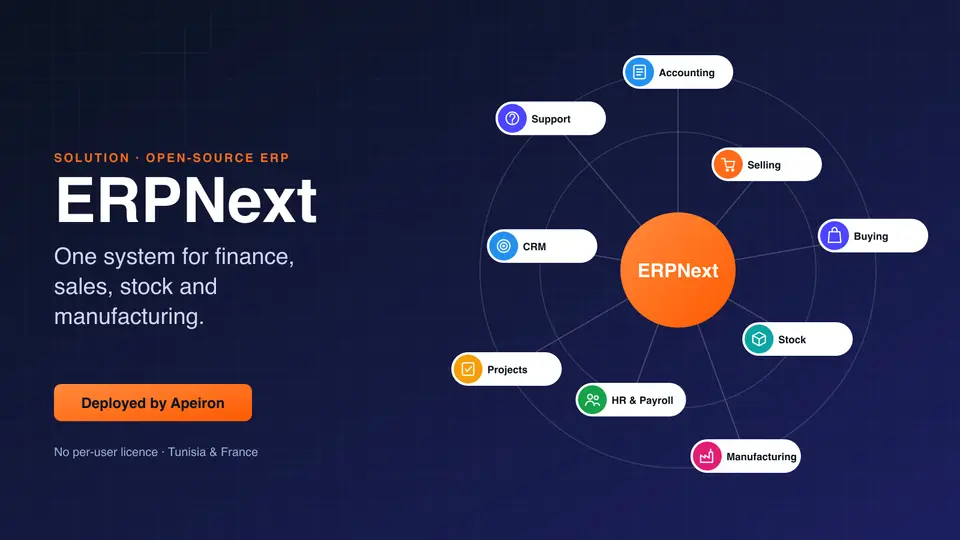
ERPNext — the open-source ERP, implemented by Apeiron
"One system for finance, sales, purchasing, stock, manufacturing and HR — with no per-user licence and no vendor holding your data."
At a glance
- Category: open-source ERP (Enterprise Resource Planning)
- Technology: Frappe Framework, Python, MariaDB, Redis — licence GPLv3
- Coverage: accounting, selling, buying, stock, manufacturing, HR and payroll, projects, CRM, support, assets, quality, website and POS
- Billing model: no per-user licence — you pay for implementation, hosting and support, not for seats
- Delivered by Apeiron: scoping, configuration, localisation (Tunisia and France), data migration, custom apps, integrations, training and support
What is ERPNext?
ERPNext is a complete, open-source business management platform created by Frappe Technologies and built on the Frappe Framework, a full-stack web framework written in Python and JavaScript. Over the years it has grown from a tool for small businesses into a system trusted by manufacturers, distributors, service companies, schools and NGOs around the world.
An ERP replaces the patchwork most companies live with: an accounting package, a spreadsheet for stock, another one for production, a separate CRM and an HR tool nobody trusts. In ERPNext all of these live in one application on one database. A sales order, a stock movement and an accounting entry are not three things to reconcile — they are three views of the same transaction.
Because the source code is open, you can read it, audit it, host it where you want and adapt it without asking permission. That is the real difference with proprietary ERPs, and it is why more and more Tunisian and French companies are looking at ERPNext as a long-term foundation.
Why companies choose ERPNext
- No per-user licence. Adding a salesperson, an accountant or a warehouse operator does not change your software bill. The budget is spent on making the system fit your business.
- One data model. Every module reads and writes the same records: no synchronisation jobs, no duplicated customers, no month-end reconciliation marathon.
- Open code, no lock-in. Your data stays in a standard database you control. You can change integrator, host or version without losing anything.
- Modern, usable interface. A responsive web interface, global search, keyboard shortcuts, list and report views users can configure themselves.
- Built for adaptation. Custom fields, workflows, print formats, scripts and full custom apps let the ERP follow your processes instead of the opposite.
- Multi-company, multi-currency, multilingual. Including French, Arabic and right-to-left layouts, which matters for teams working in both languages.
- An API for everything. Every document is available through a REST API and webhooks, so the ERP can talk to your shop, your bank or your AI agents.
The modules
ERPNext covers the whole company from a single menu. The modules below are the ones we deploy most often; you switch on only what you need and add the rest later.
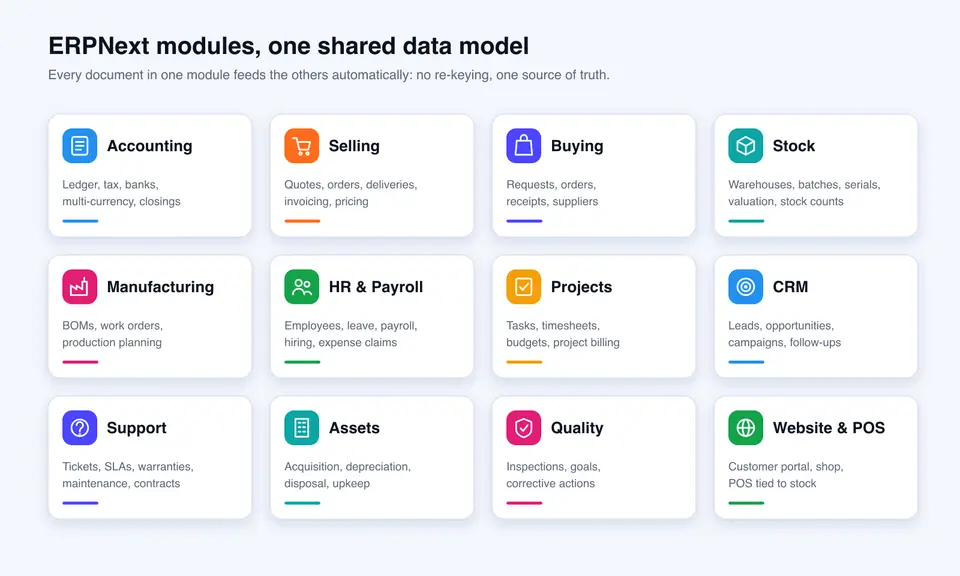 Twelve modules, one shared data model: every document in one module feeds the others.
- Accounting: general ledger, chart of accounts, receivables and payables, VAT and withholding taxes, bank reconciliation, budgets, multi-currency, period closing.
- Selling: quotations, sales orders, delivery notes, sales invoices, price lists, discounts, sales team commissions.
- Buying: material requests, supplier quotations, purchase orders, goods receipts, purchase invoices, supplier scorecards.
- Stock: multiple warehouses, batches and serial numbers, valuation methods, stock reconciliation, reorder levels, landed costs.
- Manufacturing: bills of materials, work orders, routings and workstations, production planning, subcontracting, job cards.
- HR and payroll (the Frappe HR app): employees, attendance, leave, expense claims, recruitment, payroll with local rules.
- Projects: tasks, timesheets, project budgets, billing by milestone or by time.
- CRM: leads, opportunities, campaigns, follow-up reminders, direct conversion into quotations.
- Support and maintenance: tickets, SLAs, warranty claims, maintenance schedules and visits.
- Assets: acquisition, depreciation schedules, disposal, preventive maintenance.
- Quality: inspections, quality goals, corrective and preventive actions.
- Website and POS: customer portal, simple online catalogue, point of sale connected to live stock.
One flow, from quote to cash
The strength of an integrated ERP is easiest to see on the most common flow in any company: selling something.
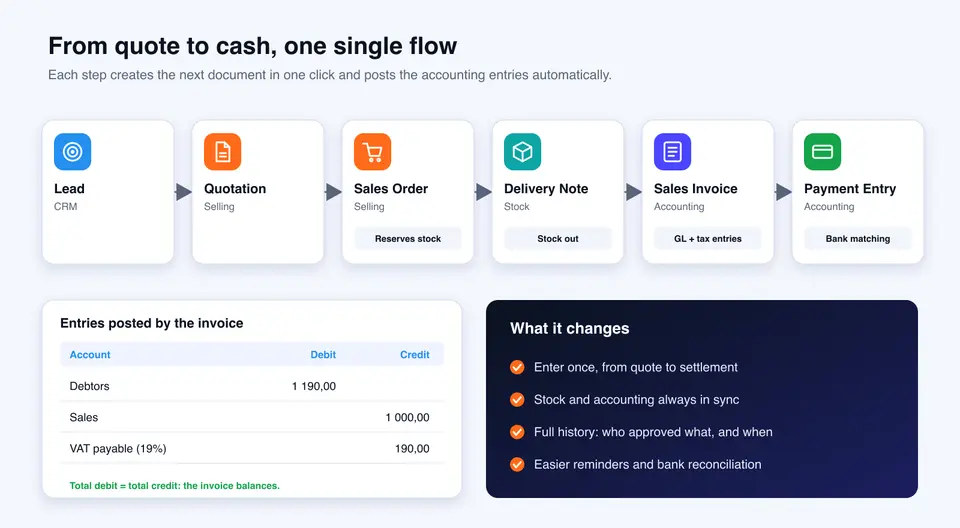 Each step creates the next document in one click and posts the accounting entries automatically.
- A lead from your website or a call becomes an opportunity and a quotation.
- The accepted quotation becomes a sales order, which reserves stock and triggers purchasing or production if something is missing.
- The warehouse ships with a delivery note, and stock levels and valuation update immediately.
- The sales invoice is generated from the delivery, posts the revenue and VAT entries and feeds the receivables ageing.
- The payment entry is matched with the bank statement and closes the invoice.
Nobody retypes a customer name, a quantity or a price. The same chain exists on the purchasing side (request, order, receipt, invoice, payment) and in production (bill of materials, work order, finished goods).
The interface in practice
Below are views of the ERPNext interface as our clients' teams use it every day. They are reconstructions of typical screens with sample data — not captures of a client's live system.
A dashboard that answers the manager's questions
Each module has a workspace with number cards, charts and shortcuts. Revenue, receivables, payables and cash are visible in one glance, and every number opens the underlying report.
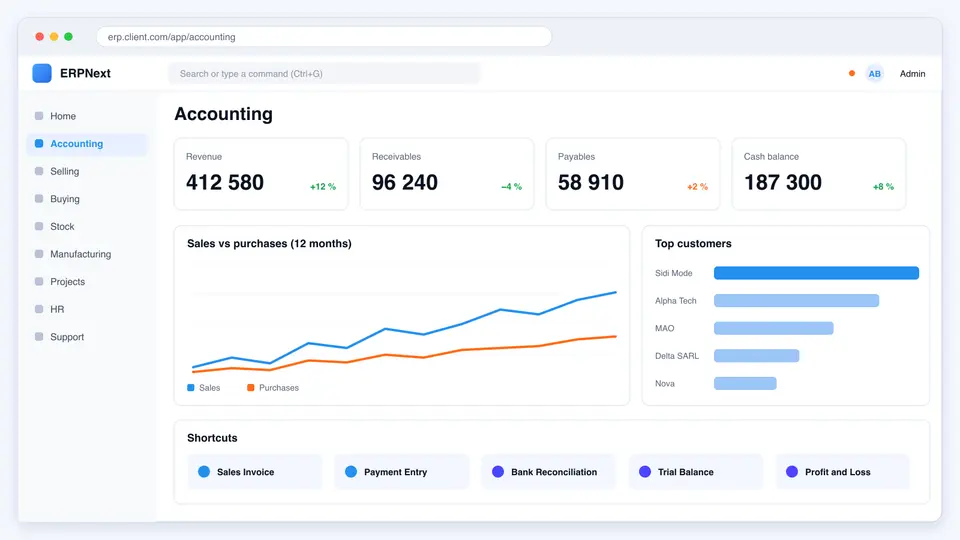 The accounting workspace: key figures, trends and shortcuts to the most frequent documents.
An invoice that posts itself
A sales invoice carries customer, taxes, items and totals, and generates the ledger entries at submission. The tax template applies the correct VAT, and the linked entries are one click away.
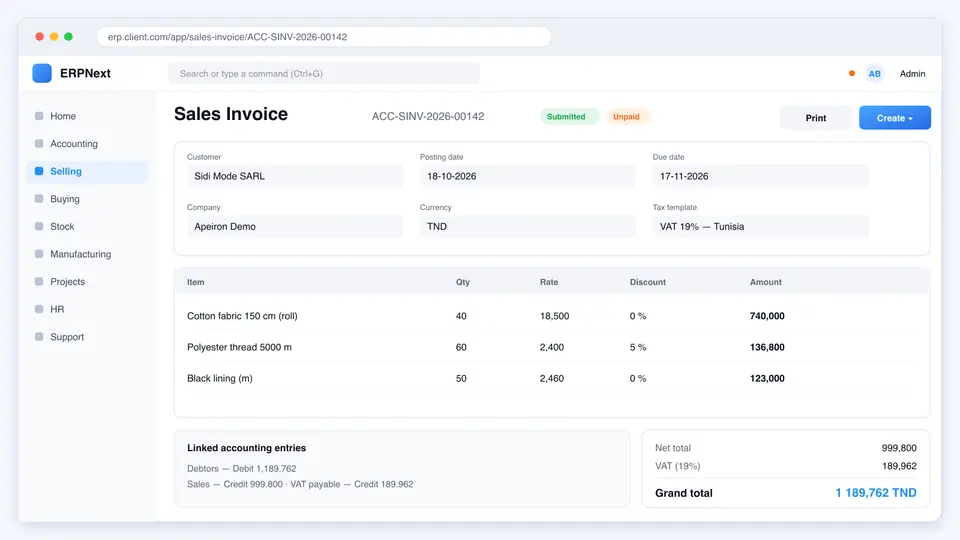 A submitted sales invoice: items, VAT template, totals and the accounting entries it generated.
Stock you can trust
The stock balance report shows quantity and value per item and warehouse, and flags what is under its reorder level. Low stock can create a purchase request automatically.
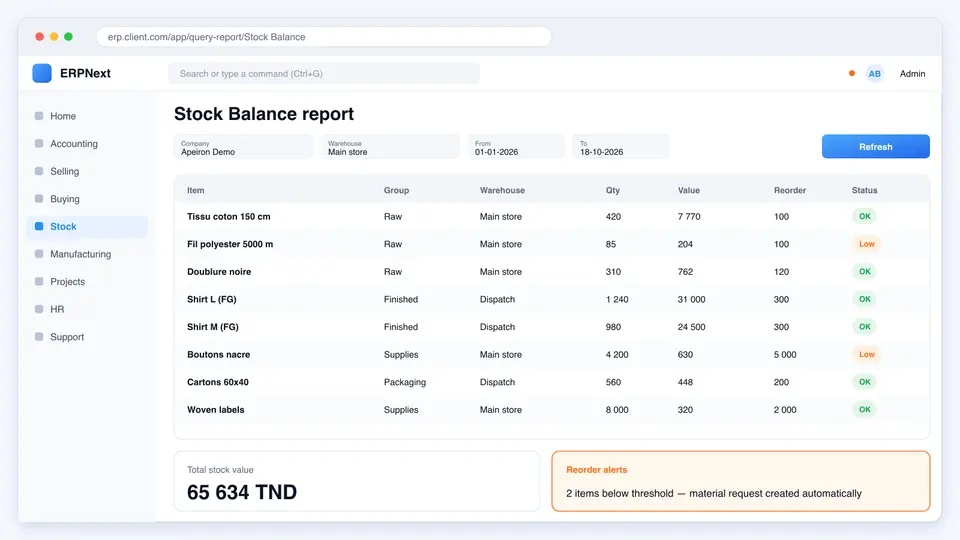 The stock balance report: quantities, valuation and reorder alerts per item and warehouse.
Production under control
A work order links a bill of materials, the raw materials to consume, the operations and the workstations. Teams see what is produced, what is late, what material is missing and what the batch costs.
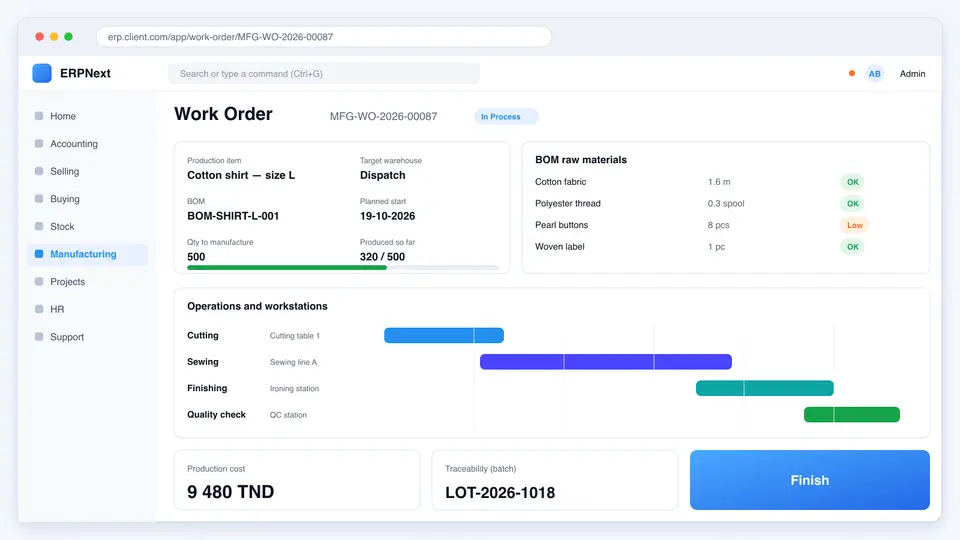 A work order: bill of materials, operations by workstation, cost and traceability.
Technical architecture
ERPNext is a standard, well-understood web stack, which keeps it easy to host, secure and maintain.
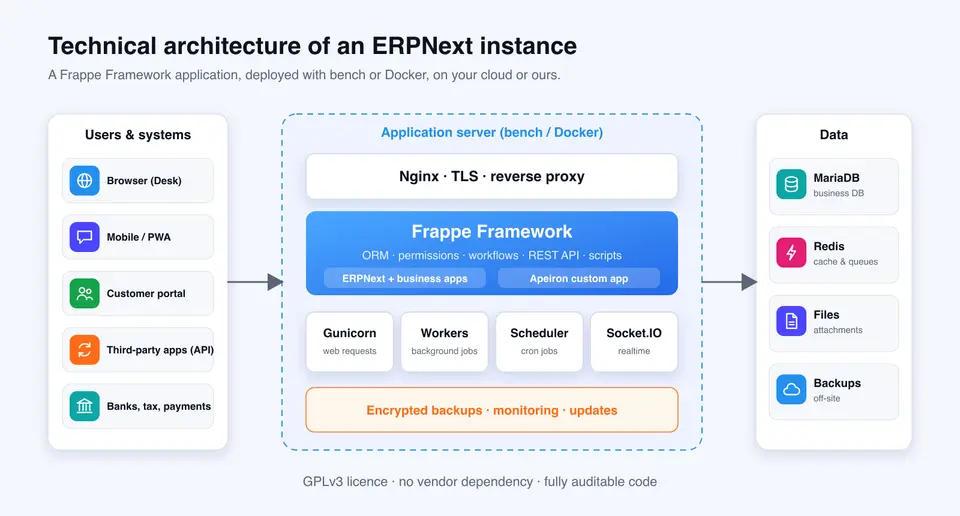 An ERPNext instance: a reverse proxy, the Frappe application with its workers and scheduler, and a data layer made of MariaDB, Redis, files and backups.
- Application: Frappe Framework (Python) serving the web interface and the REST API, with ERPNext and any custom app installed on top.
- Processes: web workers, background workers, a scheduler for recurring jobs and a Socket.IO service for real-time updates.
- Data: MariaDB for business data, Redis for cache and job queues, file storage for attachments.
- Operations: managed with the
benchcommand-line tool or with Docker containers, behind Nginx and TLS. - Resilience: encrypted backups kept off-site, monitoring and a documented upgrade procedure.
Adapting ERPNext without breaking it
Every company has a process that no standard software anticipates. The question is how to cover it without making the system impossible to upgrade. We work in three levels and always choose the lightest one that solves the problem.
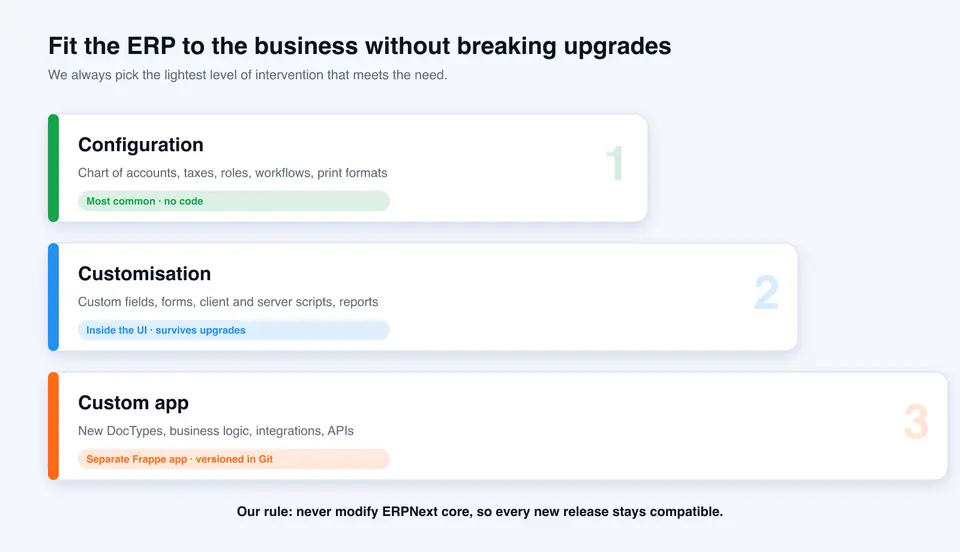 Configuration first, customisation second, a custom app only when it is really needed.
- Configuration — chart of accounts, tax templates, roles and permissions, workflows, print formats, naming series. No code, the most common case.
- Customisation — custom fields, form layouts, client and server scripts, custom reports and dashboards, all stored in the database and preserved across upgrades.
- Custom app — new document types, business logic, integrations and APIs, packaged as a separate Frappe app versioned in Git.
Our rule is simple: we never modify ERPNext core. That way every new release stays compatible and your system does not turn into a fork nobody dares to touch.
Integrations: the ERP at the centre of your information system
An ERP is rarely alone. Through its REST API, webhooks and custom apps, ERPNext connects to the rest of your ecosystem.
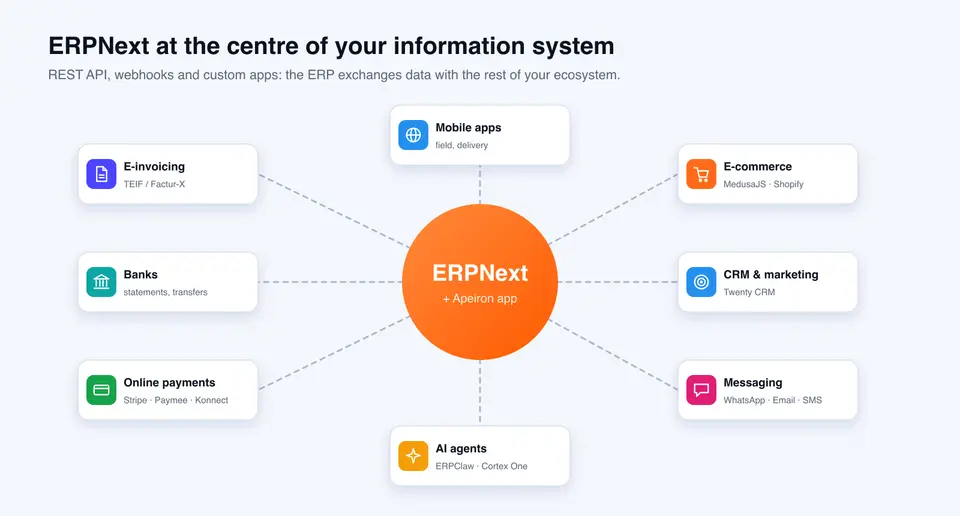 E-invoicing, banks, payments, e-commerce, CRM, messaging, mobile apps and AI agents around a single ERP.
- E-invoicing and tax authorities: preparing the formats and exports required locally.
- Banks and payment gateways: statement import, reconciliation, online payment links.
- E-commerce: a storefront on MedusaJS or Shopify, with products, stock, prices and orders synchronised with the ERP.
- CRM: if you prefer a dedicated CRM, Twenty CRM can feed leads and customers to the ERP.
- Messaging: invoices, reminders and delivery notices by email, SMS or WhatsApp.
- Mobile apps: field sales, delivery, inventory counting, built on the ERP API — see our mobile development.
- AI agents: assistants that read and write ERP data under the right permissions — see ERPClaw, Cortex One and Stray.
Localisation: Tunisia and France
A generic ERP is not enough: an invoice in Tunis and an invoice in Paris do not follow the same rules. Local adaptation is a large part of our work.
In Tunisia, we configure and, where needed, develop:
- the chart of accounts aligned with the Tunisian accounting framework, in French;
- VAT rates (19%, 13%, 7%), the stamp duty (timbre fiscal) and withholding tax on supplier payments;
- Tunisian dinar management with foreign-currency purchases and revaluation;
- invoice and document layouts compliant with local requirements, and the preparation of electronic invoicing exchanges;
- payroll rules and statutory declarations specific to the company.
In France, we work with:
- the Plan Comptable Général, VAT regimes and the accounting entries file (FEC) export;
- invoice layouts and the preparation of electronic invoicing in line with the French reform timetable;
- SEPA payments and bank reconciliation;
- French payroll through dedicated connectors or an external payroll provider, depending on your situation.
Because our team works between Tunisia and France, we can run a project with French-speaking, Arabic-speaking and English-speaking users in the same instance.
Who uses ERPNext with Apeiron
ERPNext suits companies that have outgrown spreadsheets and basic accounting software but do not need a six-figure ERP programme. Typical profiles:
- Industry and textile: production control, bills of materials, batch traceability and costing — as in our work with Sidi Mode and our guide to ERPNext for textile factories in Tunisia.
- Energy and technical services: maintenance tracking, parts and stock management — as for Alpha Technologies (oil and gas).
- Services and distribution: automated sales, invoicing and CRM — as for My Assistance Online.
- Trade and retail: multi-warehouse stock, POS, purchasing and supplier management.
- Project-driven businesses: timesheets, budgets and milestone billing.
You can read the story of one of these projects in our ERPNext case study.
Our services around ERPNext
Apeiron covers the whole life of an ERP project, from the first workshop to long-term support. One team, one point of contact.
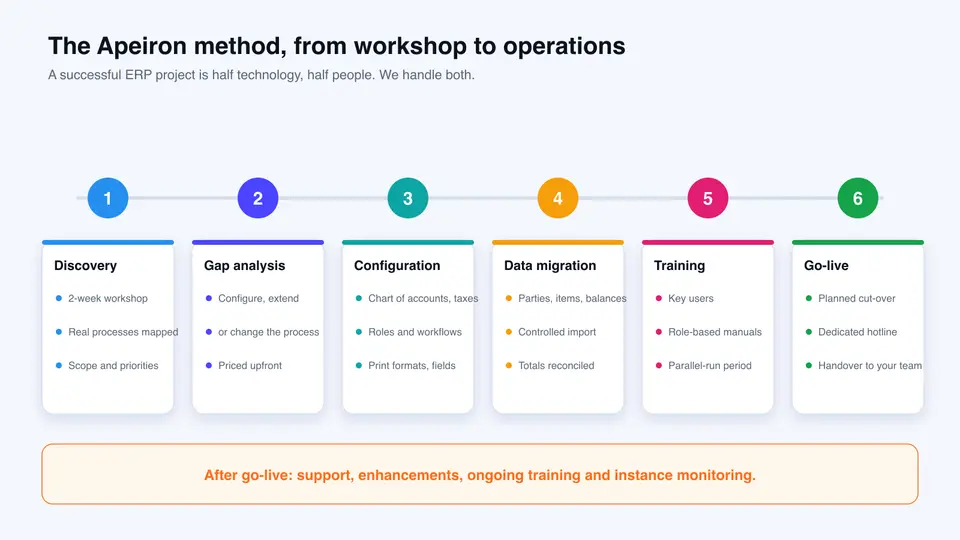 Six phases, from the scoping workshop to go-live, followed by support and enhancements.
1. Scoping and gap analysis
Every engagement starts with a workshop of about two weeks where we map your real processes, not the ones on the organisation chart. We then classify each gap as configuration, customisation or process change and price it upfront, so there are no surprises in month six. We also tell you honestly when ERPNext is not the best fit — and compare it with Odoo if relevant (see ERPNext or Odoo: which to choose?).
2. Implementation and configuration
We deploy and configure the modules you need as a coherent whole: accounting, selling, buying, stock, manufacturing, HR, projects and CRM. Roles, permissions, approval workflows, print formats and dashboards are designed with your key users.
3. Data migration
Customers, suppliers, items, opening balances, open orders and stock levels are extracted from your current tools, cleaned, loaded in a controlled way and reconciled against your accounts before go-live.
4. Custom development and integrations
When configuration is not enough, we build custom Frappe apps, reports, mobile apps and integrations with your bank, shop, CRM or business tools — always outside the ERP core.
5. Training and change management
Half of any ERP project is people. We train key users, produce role-specific manuals, run a parallel-run period and provide a support hotline until your team owns the system.
6. Hosting, support and upgrades
We can host your instance, or deploy it on your own infrastructure or cloud account. Support covers monitoring, encrypted backups, security patches, version upgrades and evolving needs, in French, Arabic and English.
7. AI on top of your ERP
Once your data is clean and structured, it becomes fuel for automation: document classification, anomaly detection, natural-language reporting, assistants for sales or purchasing. We build these with our AI team — see our AI agency in Tunisia.
Deployment options
- Managed by Apeiron: we host, back up, monitor and update the instance for you.
- Your own cloud or servers: we install and operate on your infrastructure, for data-sovereignty or compliance reasons.
- Frappe Cloud: the official managed hosting by the framework's creators, when it fits your needs.
In all cases the data is yours, in a standard database, and you keep the freedom to move.
ERPNext, Odoo or another ERP?
| Criterion | ERPNext | Odoo |
|---|---|---|
| Licence | Fully open source (GPLv3) | Community open source + paid Enterprise edition |
| Per-user cost | None | Per user in the Enterprise edition |
| Modularity | One integrated core with optional apps | Very modular, large app ecosystem |
| Customisation | Full code access, custom Frappe apps | Full code access in Community; limits depend on edition |
| Best for | SMEs and mid-sized companies wanting control and predictable cost | Companies wanting a wide catalogue of ready-made apps |
Both are good products. The right answer depends on your processes, your budget and your team — which is exactly what our scoping workshop is for. We also integrate Odoo.
How much does an ERPNext project cost?
The software has no per-user licence, so the budget depends on the work, not on the number of seats:
- the scope: number of modules, companies, warehouses and users;
- the gap between standard ERPNext and your processes (configuration is cheap, custom development is not);
- the quantity and quality of the data to migrate;
- the integrations and localisation required;
- the hosting model and the level of support.
We provide a fixed, itemised quote after the scoping workshop. A focused first phase (finance, sales and stock for example) can go live much faster than a full multi-company programme, and we often recommend that approach.
Why choose Apeiron
- A team that implements ERP every day: textile, oil and gas, services, retail — we adapt each module to your structure instead of asking you to adapt to the software.
- Tunisia and France: local accounting, tax and language knowledge, with teams on both sides.
- Open and transparent: open-source technology, no hidden licence, code and data you own.
- End-to-end: ERP, mobile apps, e-commerce and AI from the same team, so integrations are designed, not patched.
- Accountable delivery: gaps priced upfront, parallel-run, training and a support hotline until you are autonomous.
Frequently asked questions
What is ERPNext?
ERPNext is an open-source ERP built on the Frappe Framework. It manages accounting, sales, purchasing, stock, manufacturing, HR, projects, CRM and support in a single application with one shared database.
Is ERPNext really free?
The software is free and open source (GPLv3), with no per-user licence. You pay for the services around it: implementation, configuration, hosting, training and support. That is why the cost is predictable and does not grow with the number of users.
Is ERPNext suitable for a Tunisian company?
Yes. It supports multiple currencies, French and Arabic, and can be configured for the Tunisian chart of accounts, VAT rates, stamp duty and withholding tax. Apeiron handles this localisation and prepares your invoices and exports for local requirements.
Can ERPNext be used in France?
Yes. We configure the Plan Comptable Général, VAT regimes, the FEC export, SEPA payments and the preparation of electronic invoicing in line with the French reform timetable.
How long does an ERPNext implementation take?
It depends on the scope. A focused first phase can go live in a matter of weeks, while a multi-company, multi-module programme with heavy migration takes several months. We give a realistic schedule after the scoping workshop and often recommend going live in phases.
Can ERPNext be customised without breaking upgrades?
Yes, if it is done properly. We prefer configuration, then customisation stored in the database, and only then custom Frappe apps — and we never modify the ERPNext core. This keeps every new release compatible.
Can we migrate from our current software or from spreadsheets?
Yes. We extract, clean and load your customers, suppliers, items, opening balances, open orders and stock, then reconcile the totals against your accounts before go-live.
Where is our data hosted? Who owns it?
You own it. It sits in a standard MariaDB database that can be hosted by Apeiron, on your own servers or cloud account, or on Frappe Cloud. Encrypted backups and a documented restoration procedure are part of the service.
Does ERPNext integrate with our e-commerce site, bank and other tools?
Yes. ERPNext exposes a REST API and webhooks, and we build integrations with online shops (MedusaJS, Shopify), banks, payment gateways, messaging channels, CRMs and mobile apps.
How does ERPNext compare with Odoo?
Both are solid. ERPNext is fully open source with no per-user fee and one integrated core; Odoo offers a large catalogue of apps with a paid Enterprise edition. We compare them on your own processes during the scoping workshop and recommend the better fit, even if that is not ERPNext.
Can Apeiron add AI to our ERP?
Yes. Once data is structured, we build assistants and automations on top of it: document classification, anomaly detection, natural-language reports and agents that act on ERP data with the right permissions.
Do you provide support after go-live?
Yes. We offer a support hotline, monitoring, backups, security patches, version upgrades and continuous improvement, in French, Arabic and English.
See also
- ERPNext implementation partner (integrator)
- ERPNext case study
- ERPNext or Odoo: which ERP to choose?
- ERPNext for textile factories in Tunisia
- ERPClaw — the AI-native ERP
- Odoo integrator
- Our work
Ready to scope your ERPNext project?
Tell us about your processes, your teams and your constraints. We will come back with a scoping proposal and an honest view of whether ERPNext is the right choice.
- Contact Apeiron: contact@apeiron-tech.com
- Tell us about your project