
Integrating Hermes and OpenClaw in the Enterprise: The Complete Guide
Architecture, security, governance and ROI: how to integrate the Hermes and OpenClaw AI agents with your ERP, CRM and ITSM, plus a 90-day roadmap.
In short. OpenClaw and Hermes are the two most widely adopted open-source AI agents of 2026. The first excels as a conversational front door wired into your messaging tools; the second as a background agent that remembers, learns and carries out long-running tasks. Together they can become a real execution layer for the enterprise, on one condition: they must run through a control plane that IT owns (identity, policies, MCP, DLP, audit). This guide covers the architecture, security, governance, use cases and a 90-day roadmap.
Why Hermes and OpenClaw matter to enterprises now
In a few months, "personal" AI agents moved off developers' laptops and into business teams. Two projects drove that shift:
- OpenClaw, created by Peter Steinberger (founder of PSPDFKit), launched in late 2025 as Clawdbot, renamed Moltbot and then OpenClaw in January 2026. MIT-licensed, it became one of the most-starred repositories on GitHub and is now stewarded by an independent open-source foundation.
- Hermes Agent, released by Nous Research in February 2026, also under the MIT licence. Its distinguishing feature is a built-in learning loop: the agent turns successful tasks into reusable skills. Nous Research has since announced an offering aimed at businesses.
What we see at Apeiron with our clients is always the same: employees are already using these agents, often on personal machines, with their own API keys and direct access to their messaging accounts. This "shadow AI" delivers real productivity gains, along with risks IT cannot see. The right answer is not to ban it, but to provide a governed enterprise version that is more useful than the home-made one.
OpenClaw and Hermes: two agents, two roles
The two projects overlap (messaging, tools, scheduling), but their centre of gravity differs. That difference is what lets you combine them instead of picking one.
| Criterion | OpenClaw | Hermes Agent |
|---|---|---|
| Best role | Conversational front door, responsiveness | Deep work, long-running and recurring tasks |
| Technical core | Always-on Gateway: sessions, channel routing, tools | Agent runtime with persistent memory and a learning loop |
| Channels | WhatsApp, Telegram, Slack, Discord, Signal, Teams via integrations, WebChat | Telegram, Discord, Slack, WhatsApp, Signal, email |
| Extensions | Skills described by a SKILL.md file (public ClawHub registry) | Skills generated and refined by the agent, agentskills.io standard, plus MCP tools and servers |
| Memory | Session context and workspace files | Cross-session memory, FTS5 full-text search, user model |
| Execution | Shell, browser, files, cron, webhooks | 40+ tools, isolated sub-agents, 7 terminal backends (Docker, SSH, Daytona, Modal…) |
| Models | Provider of your choice (Claude, GPT, local models) | Provider of your choice (Nous Portal, OpenRouter, Anthropic, OpenAI, NVIDIA NIM, private endpoint) |
| Licence | MIT | MIT |
Our take: OpenClaw is the best "receptionist": it sits where your teams already are, answers fast and triggers simple actions. Hermes is the best "analyst": it takes on a multi-hour task, breaks it down, completes it and remembers how next time.
The reference architecture
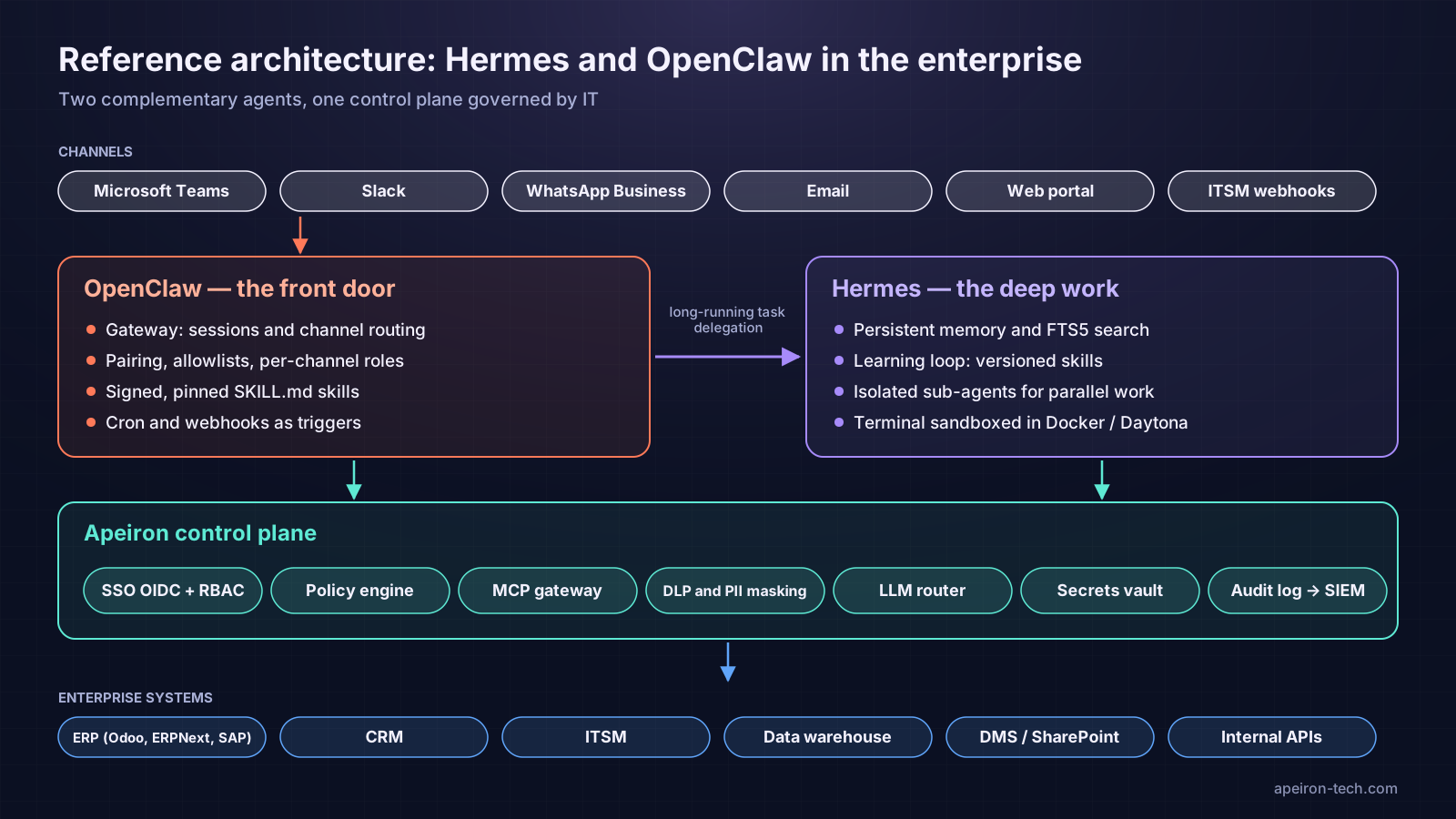
The architecture we deploy has four layers.
1. Channels
Employees talk to the agents where they already work: Microsoft Teams, Slack, WhatsApp Business, email, an internal web portal, plus webhooks from your ITSM (ServiceNow, Jira Service Management, GLPI) or ERP. No new tool to learn, which is the first driver of adoption.
2. The two agents
- OpenClaw receives messages through its Gateway, identifies the session, handles short requests (order status, ticket summary, document search) and delegates anything long, expensive or recurring to Hermes.
- Hermes runs those background tasks in a sandbox (Docker or Daytona), uses sub-agents to parallelise, and captures what it learns as versioned skills.
3. The control plane
This is the piece home-grown deployments forget, and it is what makes the whole thing acceptable to a CIO, a CISO and a DPO:
- OIDC SSO and RBAC (Entra ID, Okta, Keycloak): every request is tied to a person and their actual permissions.
- Policy engine (for example OPA): which skills, tools and data for which role, and when.
- MCP gateway: agents never call a system directly. They go through MCP servers exposing specific operations with scopes (read, write, maximum amount).
- DLP and personal data masking before anything is sent to an external model.
- LLM router: frontier model (Claude, GPT) for complex reasoning, self-hosted model for sensitive data, a small model for triage, with a cost cap per team.
- Secrets vault (Vault, Azure Key Vault) and short-lived OAuth tokens: no long-lived keys in a config file.
- Audit log shipped to the SIEM: every prompt, tool call, parameter and approval.
4. Enterprise systems
ERP (Odoo, ERPNext, SAP), CRM (Salesforce, HubSpot, Twenty), ITSM, data warehouse (BigQuery, Snowflake, PostgreSQL), document management (SharePoint, Google Drive, Confluence) and internal APIs. Each system is exposed by a dedicated MCP server, versioned and tested like any other software component.
A request's lifecycle, step by step
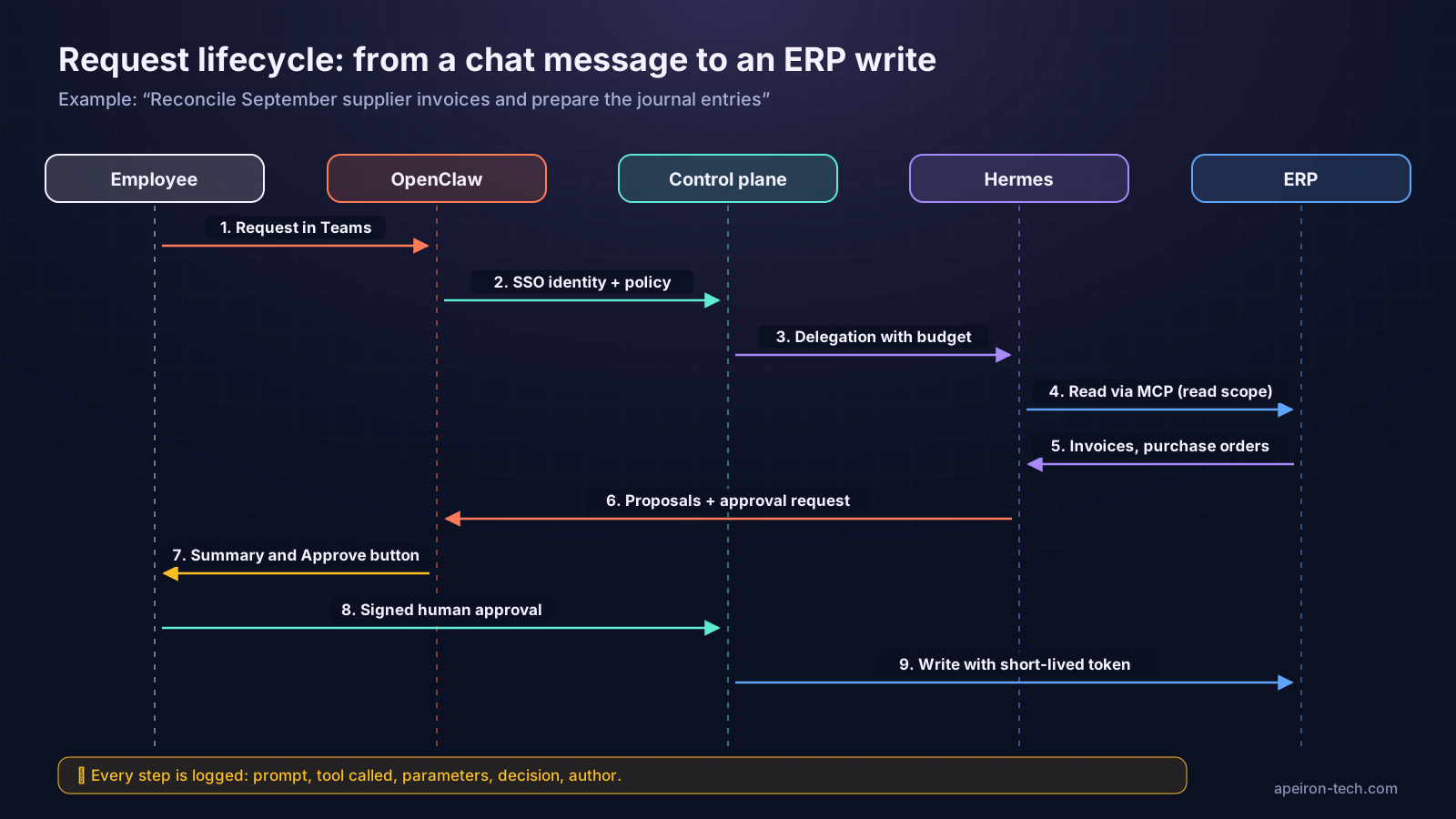
Take a real request from an accounts-payable team: "Reconcile September supplier invoices and prepare the journal entries."
- The request arrives in Teams. OpenClaw receives it and opens a session tied to the user.
- Identity and policy check. The control plane verifies the SSO token, the role (AP accountant) and the policy: reconciliation allowed, any write requires approval.
- Delegation to Hermes with an explicit budget: maximum duration, token count, capped cost.
- Read through MCP: Hermes queries the ERP with a read-only scope (invoices, purchase orders, goods receipts).
- Analysis: three-way matching, detection of price or quantity gaps, duplicates and inconsistent VAT.
- Proposals and approval request: Hermes sends OpenClaw a summary (182 invoices matched, 9 discrepancies, 2 suspected duplicates) and the proposed entries.
- The user sees the summary in Teams with an "Approve" button and the discrepancy details.
- Signed human approval, recorded with the approver's identity.
- Write to the ERP via MCP, with a short-lived token scoped to that single operation.
At every step, the audit log records what was seen, decided and executed. If the task recurs monthly, Hermes proposes turning it into a skill, which then goes through the review process described below.
The Hermes learning loop, under governance
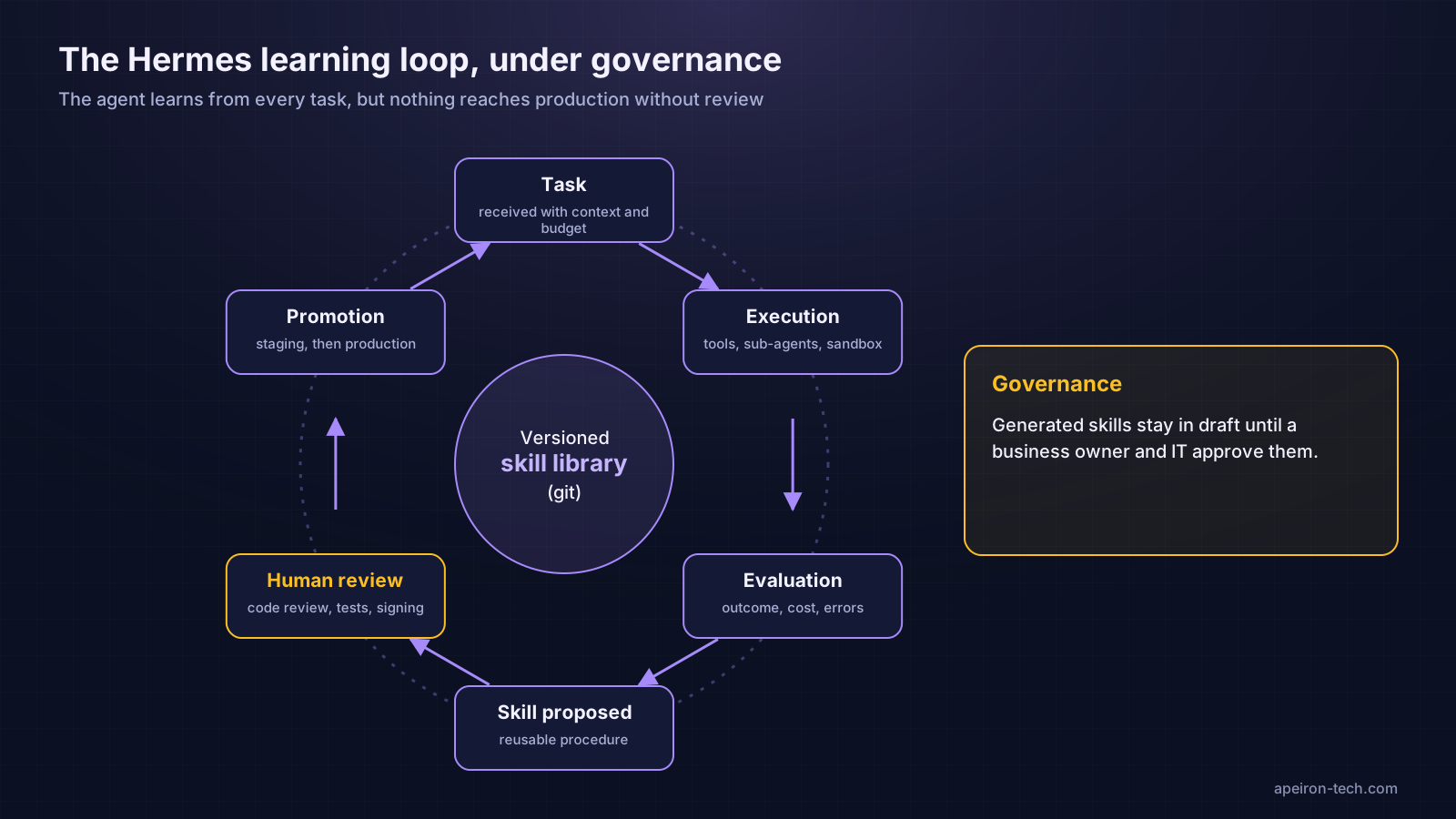
Hermes's greatest strength is also what worries CISOs: an agent that writes its own procedures. In the enterprise, we frame that loop as follows:
- Generated skills start as drafts in an internal git repository, never directly in production.
- Mandatory human review: a business owner validates the logic, a developer reviews the code and tool calls, and automated tests replay real anonymised cases.
- Signing and promotion: production agents only load signed skills, each with a version number and a changelog.
- Instant rollback: a skill that drifts (error rate, cost, user complaint) is disabled in one click from the control plane.
The result: the company builds up a library of automated procedures that are documented and auditable, instead of know-how scattered across individual prompts.
Security: treat agents as non-human identities
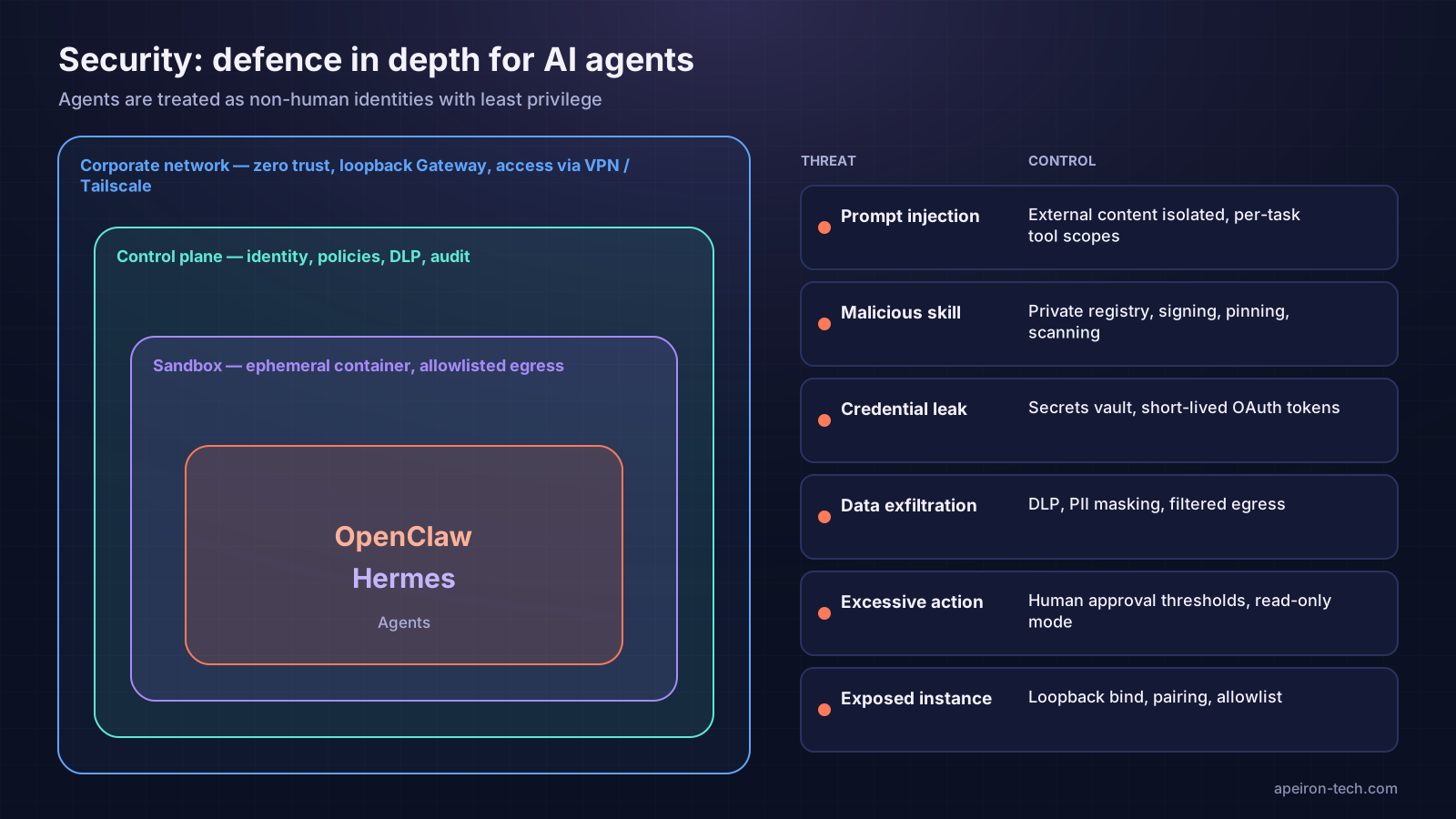
2026 showed in practice what a poorly deployed agent can cost. Researchers counted tens of thousands of OpenClaw instances exposed on the internet (over 21,000 according to Censys at the end of January 2026), and campaigns of malicious skills published on the public ClawHub registry. The Cloud Security Alliance published a dedicated zero-trust hardening guide in March 2026, and several vendors (NVIDIA with NemoClaw, AI and MCP gateways) now offer enterprise distributions or security layers.
The principle we apply: an agent is a non-human identity with the least privilege possible. In practice:
- Network: OpenClaw Gateway bound to loopback, remote access via VPN or Tailscale, never directly exposed. Messaging pairing enabled and a minimal allowlist.
- Sandbox: Hermes and shell tools run in ephemeral containers, with no access to the host file system and an allowlist of network destinations.
- Skill supply chain: private registry, no installs from ClawHub without review, pinned versions, signing, automated scanning. Skills whose prerequisites call for
curl | bashor a downloaded binary are rejected outright. - Secrets: nothing in plain text in
~/.openclaw/or config files. A secrets vault and short-lived OAuth tokens. - Prompt injection: all external content (email, web page, attachment) is treated as untrusted. Available tools are scoped per task, and any high-impact action (payment, customer email, deletion) requires human approval.
- Monitoring: skill installs, tool calls, outbound connections and config changes flow to the SIEM with dedicated alerts.
Compliance: GDPR, the EU AI Act, ISO 27001
Agent deployments almost always touch personal data. Points to watch:
- GDPR: an up-to-date record of processing, a DPIA when agents handle HR, customer or health data, minimisation and masking before any call to a model hosted outside the EU, and a defined retention period for logs.
- EU AI Act: most internal use cases (support, finance, IT) fall under transparency and AI-literacy obligations, but an agent involved in hiring, employee evaluation or credit decisions can move into the high-risk category. Qualify this during scoping.
- ISO 27001 and SOC 2: control-plane logs provide the expected evidence (access management, traceability, change management for skills).
- Sovereignty: for the most sensitive data, Hermes and OpenClaw can run against a self-hosted model, in your cloud or on-premises. The LLM router enforces this automatically based on data classification.
Concrete use cases
Finance and accounts payable
Matching invoices, orders and receipts, detecting duplicates, preparing entries and reminders. Hermes handles the volume, people approve the exceptions.
Customer and internal support
OpenClaw answers common questions in Teams or WhatsApp Business using the knowledge base, creates and enriches ITSM tickets, and hands off to a person with a summary when a request falls outside its scope.
Sales operations
Lead enrichment, qualification, CRM updates after each meeting from the notes, meeting summaries and follow-ups.
IT and DevOps
Analysing monitoring alerts, first-line diagnosis, opening correlated tickets, weekly vulnerability reports, with commands executed only in isolated environments.
Procurement and supply chain
Comparing supplier quotes, tracking late deliveries, stock-out alerts from the ERP, preparing replenishment orders for approval.
Legal and compliance
First-pass contract review, extraction of risky clauses, comparison with your templates, preparation of supplier questionnaires.
Measuring return on investment
An agent project must be steered by metrics defined before the pilot:
| Metric | What it measures | How to track it |
|---|---|---|
| Handling time | Average task duration before and after | ITSM, ERP or CRM timestamps |
| Automation rate | Share of tasks completed without human intervention | Control-plane audit log |
| Accuracy | Share of proposals approved without correction | Approval feedback |
| Cost per task | Tokens, compute and licences per task | LLM router and FinOps |
| Adoption | Weekly active users | Channel analytics |
| Incidents | Reverted actions, leaks, security alerts | SIEM |
In our automation projects, the clearest gains come from high-volume tasks with explicit rules (matching, triage, data entry). We don't promise a figure before measuring your baseline: that is what the first two weeks are for.
Roadmap: 90 days from scoping to production
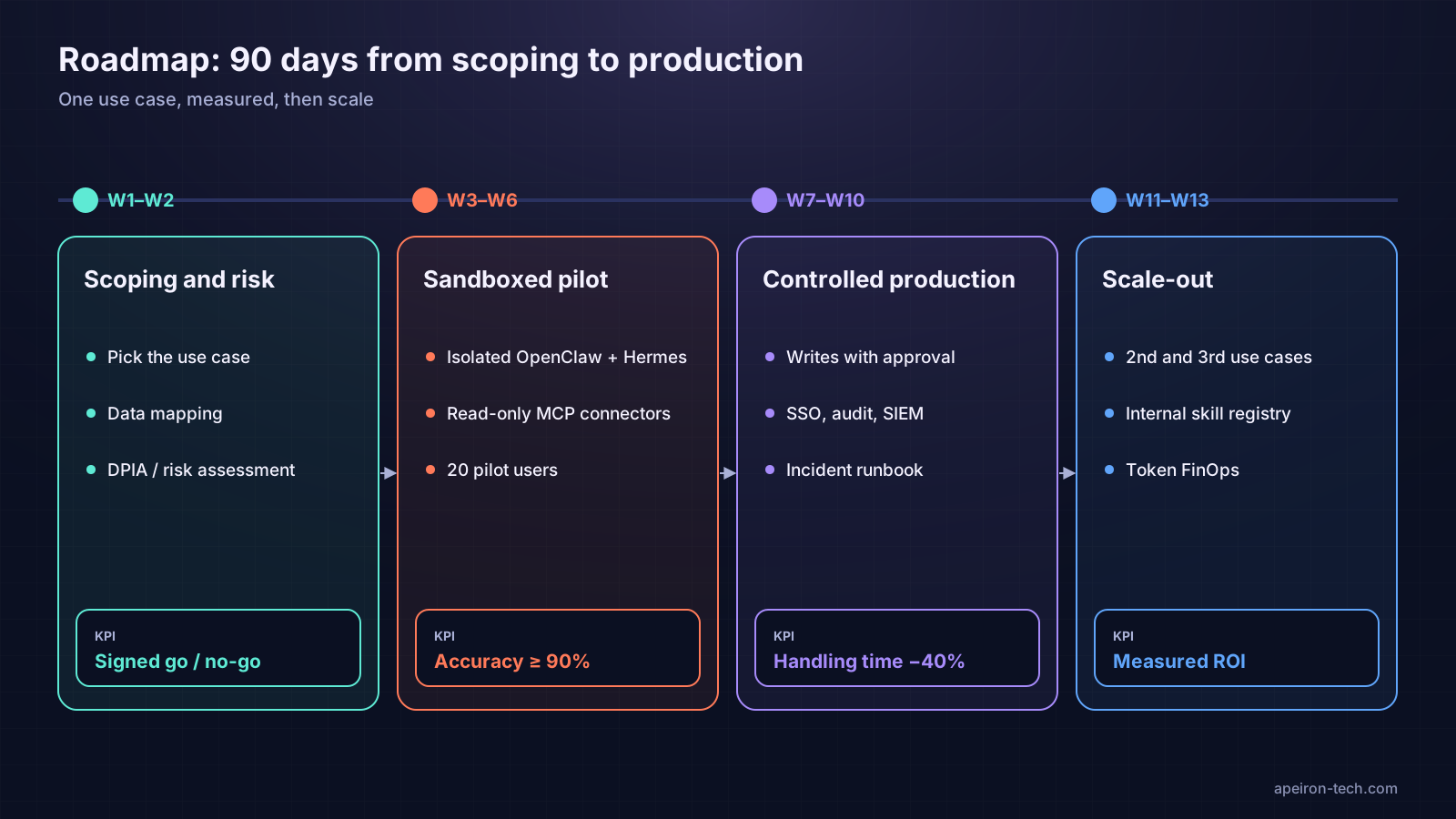
Weeks 1–2: scoping and risk. Pick a high-volume use case, map data and systems, run the impact assessment, define metrics and the go / no-go decision.
Weeks 3–6: sandboxed pilot. OpenClaw and Hermes deployed in an isolated environment, read-only MCP connectors, around twenty pilot users, accuracy measured.
Weeks 7–10: controlled production. Writes enabled with human approval, SSO integration, audit log wired to the SIEM, incident runbook and team training.
Weeks 11–13: scale-out. Second and third use cases, internal skill registry, token FinOps, quarterly AI governance committee.
The mistakes we see most often
- Giving the agent an administrator's credentials "to move faster". An agent needs its own limited service accounts.
- Installing public skills without reading them. A skill is executable code: review it like any software dependency.
- Starting with the most ambitious use case. The first project must be measurable within six weeks.
- Forgetting change management. Teams need to know what the agent does, what it doesn't, and how to correct it.
- Not capping costs. An agent stuck in a loop can burn a month's budget overnight. Set per-task and per-team budgets from day one.
How Apeiron helps
Apeiron Technologies designs and runs AI agents in production from Paris and Tunis. For Hermes and OpenClaw integration, we handle:
- audit and scoping: profitable use cases, risks, GDPR and AI Act compliance;
- the control plane: SSO, policies, MCP gateway, DLP, LLM router, audit;
- MCP connectors to your ERP, CRM, ITSM and data warehouse;
- hardening in line with zero-trust guidance and your security policy;
- operations: monitoring, skill review, FinOps, continuous improvement.
To go further, see our AI agent orchestration page, our AI agency and our self-hosted enterprise AI solution Cortex One.
Frequently asked questions
What is the difference between Hermes and OpenClaw?
OpenClaw is primarily a conversational gateway: it connects an agent to your messaging tools and performs actions through skills. Hermes, from Nous Research, is a background agent with persistent memory and a learning loop that turns successful tasks into reusable skills. In the enterprise, OpenClaw acts as the front door and delegates long-running tasks to Hermes.
Are Hermes and OpenClaw free and open source?
Yes, both projects are released under the MIT licence and can be self-hosted. The real costs come from the language models used, infrastructure, integration with existing systems and operations.
Is OpenClaw secure enough for an enterprise?
Not in its default configuration. It must be hardened: Gateway not exposed to the internet, pairing and allowlists, reviewed and pinned skills, secrets in a vault, sandboxed execution and logging to the SIEM. With those measures and a control plane, it can be used in production.
Can Hermes and OpenClaw use a model hosted in Europe or on-premises?
Yes. Both agents support multiple model providers, including a private endpoint. An LLM router can send sensitive data to a self-hosted model and everything else to a frontier model.
How do we connect the agents to our ERP or CRM?
Through dedicated MCP servers behind an MCP gateway. Each server exposes specific operations with limited rights (read, write, maximum amount), so the agent never gets direct database access.
How long does a first deployment take?
Allow about six weeks for a measured pilot on one use case, and around twelve weeks for controlled production with SSO, audit and human approvals.
Does the EU AI Act apply to these agents?
Yes, to varying degrees. Most internal uses fall under transparency and AI-literacy obligations. Uses involving hiring, employee evaluation or access to credit may be classified as high-risk and require a stronger framework.